
EU Ambassador visits Basilan communities, reaffirms commitment to inclusive Bangsamoro growth
Published: Apr 23, 2026 Reading time: 3 minutes Share: Share an articleBasilan, Philippines — European Union Ambassador Massimo Santoro visited coffee-growing sites in Basilan under the Bangsamoro Agri-Enterprise Programme (BAEP) – Leveraging and Expanding Agri-Aqua Production (LEAP), reaffirming the European Union’s (EU) commitment to inclusive economic growth and long-term stability in the Bangsamoro Autonomous Region in Muslim Mindanao (BARMM).
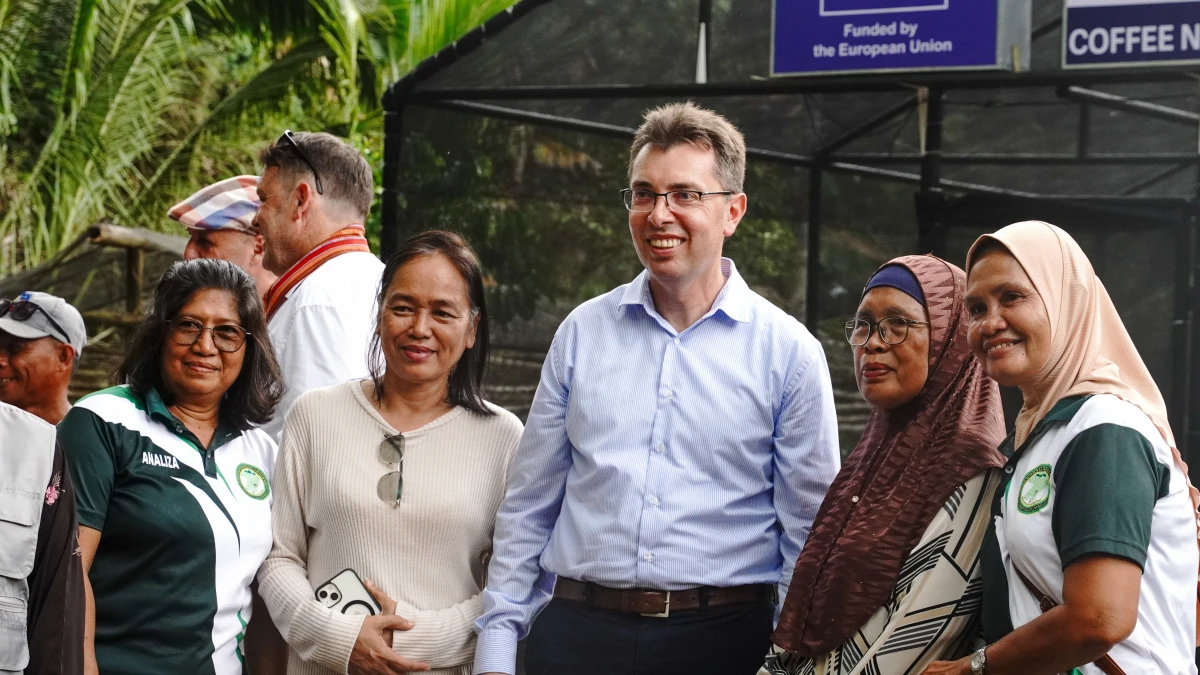
This visit highlighted how these EU-funded investments in the coffee and seaweed value chains are beginning to reshape local economies in the island provinces of Sulu, Basilan, and Tawi-Tawi, areas with strong agricultural potential that have long remained on the margins of formal markets.
Ambassador Santoro met with local government representatives, implementing partners, private sector actors and local farmers to assess how these collaborations are translating into practical support for coffee-growing communities.

Coffee producers and cooperative members shared how improvements in cultivation and processing techniques are helping raise the quality and quantity of locally produced coffee and opening new economic opportunities beyond its long-standing cultural and traditional significance in the region.
“Before, coffee in Basilan was often neglected. Through the project, we began to see its real value. We learned how to improve quality, and we were connected to buyers and quality assessors who recognize the worth of our coffee. Now, every bag we produce reflects not just our work, but the opportunities that have opened for our community,” said Edwina O. Isa of the Tubigan Farmers Association in Maluso, Basilan.
While the field visit in Basilan centered on coffee-related interventions , BAEP-LEAP implemented by People in Need (PIN) Philippines , Maranao People Development Center Inc. (MARADECA), and United Youth of the Philippines-Women Inc. (UnYPhil-Women), also supports the development of seaweed value chains across Sulu and Tawi-Tawi islands, reflecting a broader strategy to strengthen market-driven livelihoods in BARMM.

Unlike traditional aid approaches, BAEP-LEAP is designed around how markets function in practice. It works across the coffee and seaweed value chains, linking farmers, cooperatives, traders, input suppliers, and academic institutions, to address long-standing constraints that have limited productivity, quality, and access to higher-value markets.
“Conventional aid delivers inputs and services for the duration of a project; the gains often recede once funding ends. BAEP-LEAP is structured differently. The intervention targets the underlying market functions production standards, post-harvest handling, trader linkages, and cooperative capacity that determine whether coffee from Basilan and Sulu can compete beyond the project period,” said Kannan Sreedharan, PIN Philippines BAEP-LEAP Program Manager.
In Basilan, this support has focused on strengthening coffee production practices, improving post-harvest handling, and enhancing product quality so farmers can access more competitive and sustainable markets.

“When BAEP-LEAP ends, sustainability will be measured by the continued performance of these market functions, not by the volume of assistance delivered,” he added
The mission forms part of the European Union’s broader support to inclusive and conflict-sensitive development in BARMM. Through alignment with complementary initiatives such as SUBATRA, BAEP contributes to a more coherent regional strategy that links livelihoods, enterprise development, and long-term economic resilience.


